


Celtic Cup is a unique tradition rooted in friendship
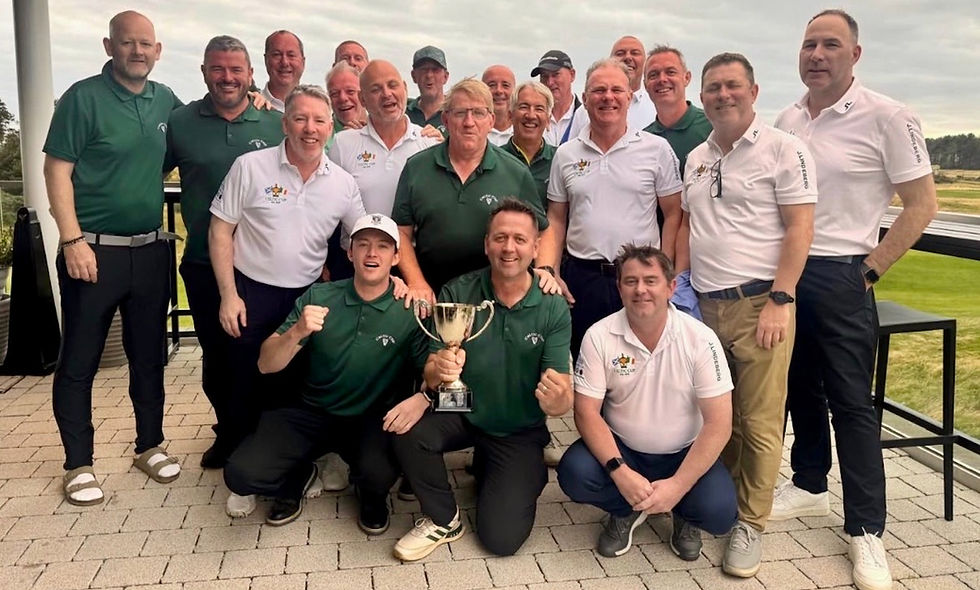
FOR more than two decades, the Celtic Cup has been a unique tradition rooted in true friendship across two Celtic countries.
What began as a gathering of golfers (above) from Ireland and Scotland has grown into something far greater than a golf competition. It has become a celebration of friendship, rivalry, travel, memories and, above all, a shared love of the game.
Over the years, players and friends have travelled the length and breadth of Ireland and Scotland, following the Celtic Cup from one venue to the next. Its reach now extends even further, with friends travelling from across England and as far afield as Spain to take part.
That commitment says much about what the Celtic Cup has become. People return year after year not simply for the chance to win, but to be part of a tradition they have helped create. Friendships have grown stronger, new friendships have been formed and countless memories have been made along the way.
The golf, of course, remains at the heart of it and the Celtic Cup has visited some outstanding courses across Ireland and Scotland, providing a constantly changing backdrop to the competition and giving the players new challenges to embrace each year.
The format mirrors the Ryder Cup, with team matches leading towards the singles. There is genuine pride in representing Ireland or Scotland and, once the competition begins, the desire to win is every bit as strong as you would expect.
Yet what makes the Celtic Cup special is the relationship between the players. Friendship is not something reserved for the clubhouse after the final putt. It is present throughout the matches themselves—in the encouragement between opponents, the laughter, the banter and the mutual respect. The rivalry is real, but so is the friendship.
This year’s battle
This year, Ireland travelled to the west of Scotland knowing they faced a formidable challenge.
Scotland were firm favourites, having won the previous two Celtic Cups on the bounce. They had the confidence that comes with recent success, while Ireland knew they would need to produce something special if they were to take the trophy back across the Irish Sea.
The competition was played at Dundonald Links and Glasgow Gailes, providing two demanding venues for another meeting between the two sides.
After the opening day, Ireland found themselves facing a significant deficit. It looked bleak. Scotland had taken control and the prospect of a third consecutive Celtic Cup victory appeared to be becoming a reality. Ireland had a mountain to climb, but the competition was far from over.
Irish fightback
Day Two brought the fourballs, and Ireland responded with determination. Match by match, they began to eat into the Scottish advantage. The deficit narrowed, confidence grew and the momentum started to turn. Suddenly, what had seemed almost impossible after day one was very much within reach. Then came Singles Day.
With everything still to play for, Ireland produced an outstanding performance. The singles team delivered an exceptional score, completing a remarkable comeback and transforming what had looked like a comfortable Scottish advantage into a dramatic finale.
It was a fitting reminder of why the Celtic Cup has endured for so long. The result mattered enormously, but so too did the character shown in getting there.
More than the score
For all the competitiveness, the Celtic Cup has always been about more than the scorecard. It is about the people who make the journey each year. It is about old friends meeting again, new friendships being formed and the anticipation of another weekend spent together. It is the conversations over dinner, the stories from previous competitions, the good-natured arguments and the inevitable banter between Ireland and Scotland. It is also about the journeys themselves—travelling hundreds of miles to meet people who, for many, have become more than golfing companions.
The competition provides the reason to come together. Golf provides the common language. The rivalry adds the edge. And the demand to be part of it tells its own story. Places are now highly sought after, with a waiting list of golfers hoping for the opportunity to join the Celtic Cup.
For a competition that began more than 20 years ago among a group of friends, that is perhaps the clearest indication of how far it has come. What started as a simple gathering has developed into an occasion people want to be part of. The established players return year after year, while new golfers are keen to earn their place and experience the unique atmosphere for themselves. That balance—between tradition and new faces—is an important part of what keeps the Celtic Cup moving forward.
The next chapter
Now, the Celtic Cup moves on to Donegal. Next year, the famous Rosapenna Links will provide the setting for the next meeting between Ireland and Scotland. Against the backdrop of the Donegal coastline, it will provide a spectacular new stage and another demanding challenge for both teams.
Ireland will arrive hoping to build on this year’s remarkable comeback, while Scotland will be determined to regain the trophy.
But long before the opening tee shot, the anticipation will already be building. Players and friends will once again make the journey from Ireland, Scotland, England and beyond, bringing with them the stories, memories and friendships that have become such an important part of the competition.
For more than two decades, the Celtic Cup has proved that competitive golf can be about much more than winning. It is about belonging, shared experiences and the friendships that develop when people come together year after year. The trophy may be the prize, but being part of the Celtic Cup is the real tradition.
So, Rosapenna Links in Donegal, 2027. Ireland versus Scotland. The battle continues!


Comments