


WB Yeats was a truly a man of Ireland

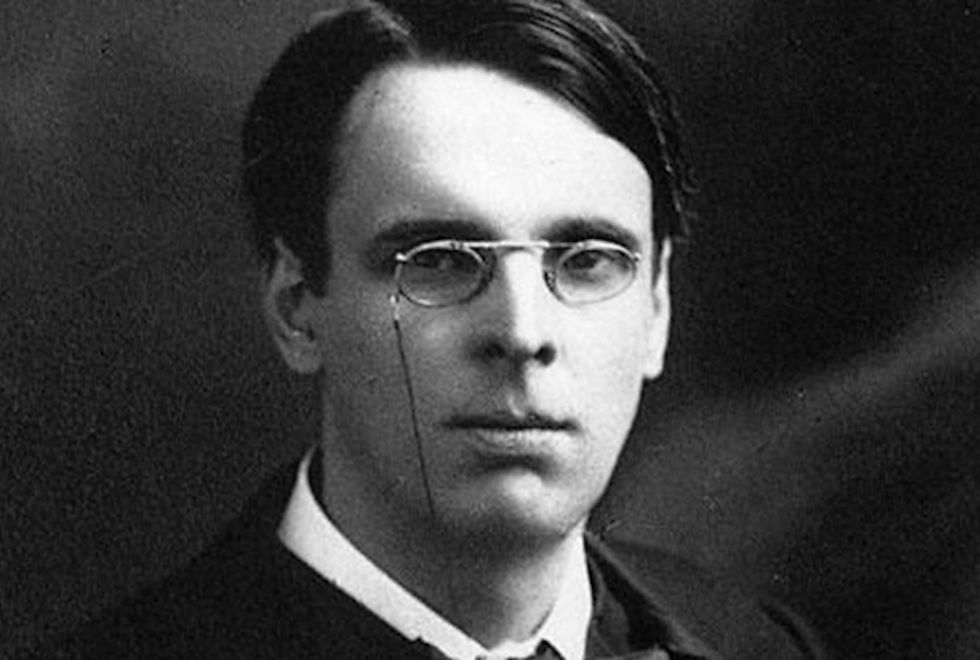
"I AM of Ireland… come dance with me in Ireland,” declared Erin’s greatest poet, WB Yeats. It is hard to overestimate the significance of Yeats to the development of modern Ireland. The Sligo poet was the artistic father of the Irish Literary Revival, and co-founder of the Abbey Theatre, which put Irish creativity at the centre stage of the emergent cultural Nationalism in the late 19th century.
When not being central to shaping the Irish national culture, Yeats gave poetic voice to the Rising of 1916 when he penned his verse Easter 1916, the verse which gave us the immortal line ‘a terrible beauty is born.’ The poem is undoubtedly the most important Irish poem of the 20th century, and its significance is still echoing across the nation more than a century after it was penned.
Yeats was not only Ireland’s first literary giant to win the Nobel Prize (1923), but also a politician. The poet served two terms in the Irish Senate during the 1920s and was vocal in his support of divorce and the rights of the minority Protestant community in the fledgling Free State.
Yet as a child, Ireland’s most lyrical of wordsmiths was a poor student at school, tone-deaf, and dyslexic. However, from these less-than-promising circumstances of his early years, Yeats emerged to become Erin’s greatest bard.
Fenian friend
William Butler Yeats (WBY) was born on June 13th, 1865, in Sandymount, Dublin, into an Anglo-Irish family. His father, John, was a barrister turned portrait painter. His mother, Susan Mary Pollexfen, came from a wealthy Sligo merchant family. The young Yeats would alternate his childhood between London, where his father was attempting to establish his artistic career, and Sligo. However, it was Sligo’s landmarks, such as Benbulbin and Lough Gill, that would capture the young poet’s imaginative heart and provide the muse for his Celtic Twilight lyric verse.
In 1884, he briefly attempted to follow in his father’s artistic footsteps, enrolling at Dublin’s Metropolitan School of Art (1884–86). It was during this period that Yeats came under the influence of Fenian leader John O’Leary. The elder statesman of physical-force Fenianism began to mentor the young Yeats on the history of Irish Nationalism, although the young bard remained to be convinced of the physical-force argument. Yet the young, genteel, middle-class Protestant was exposed to a radical Fenian tradition that was not discussed in the artistic salons of Dublin he had frequented.
At the height of his fame and cultural influence, Yeats would pay tribute to the Fenian leader and his legacy of selfless sacrifice in pursuit of Irish independence. Writing from his 15th-century tower, Thoor Ballylee (Yeats Tower) in Galway, the poet lamented how O’Leary’s Nationalism was being replaced by a nation of shopkeepers consumed by petty piety—men who were more concerned with saving a half-crown than fighting the Crown. In his poem September 1913, Yeats lamented: “For men were born to pray and save: Romantic Ireland’s dead and gone, it’s with O’Leary in the grave.” What is important to recognise is that during his life Yeats had become so culturally important that when he wrote verse such as September 1913, Ireland read what he had to say. Not everyone agreed with what he had to say, but they listened, nonetheless. His poetic disappointment at Ireland’s lack of national heroism was not lost on Connolly or Pearse as they prepared to prove Yeats wrong a mere three years later.
Celtic revival
Before Yeats’s inevitable involvement with political Nationalism, he first set his sights on the cultural revival of Ireland and its ancient Celtic mythology. His first collection of poetry, The Wanderings of Oisin (1889), was steeped in Irish myth and a longing for a more heroic Celtic past of warrior-poets. The poem The Stolen Child, which was brought to a modern audience by The Waterboys on their seminal Fisherman’s Blues album (1988), contains the lines: “Come away, O human child! To the waters and the wild, With a faery, hand in hand, For the world’s more full of weeping than you can understand.”
Yeats’ writing about faeries and Irish folklore was more than just a pleasant distraction from reality; it was an act of cultural importance which saw an Anglo-Irish Protestant reconnect with the country’s ancient Gaelic past, rich in myth and legend. What Yeats and his fellow cultural Nationalists were doing was recognising their Gaelicness and shaking their fellow Anglo-Irish out of their West Briton slumber to awaken them to their Irishness.
The context of Yeats’s engagement with Irish myth and legend should be seen in how he and others were rejecting Britishness in favour of identifying as Irish. By embracing Irishness over Britishness, Yeats and his fellow cultural Nationalists were casting off their comfortable position of being part of the elite who had access to the wealth and glory of the British Empire. Other historic Anglo-Irish figures who embraced empire—such as the Duke of Wellington, the explorer Sir Ernest Shackleton, and Lord Horatio Kitchener (‘Your Country Needs You’)—were all richly rewarded in titles and wealth by embracing the glory of Britishness. However, these cultural Nationalists were rejecting their birthright. Their identification as Irish was revolutionary in the context of the Victorian age, when the sun never set on the seemingly invincible British Empire.
Mad about Maud
The folktales of Ireland were where the young Yeats drew his creative force from, yet his meeting with Maud Gonne in 1889 made her his lifelong poetic muse. Yeats described Gonne as the most beautiful woman in Ireland, and many agreed with the poet’s description of the actress. Yet Gonne was more than mere surface beauty; it was she who politicised Yeats, not the reverse. Gonne was born into Anglo -Irish privilege, but after witnessing the brutal eviction of tenant farmers in Mayo, she dedicated her life to the cause of Irish independence. She organised protests against the extravagance of Queen Victoria’s Diamond Jubilee in 1897, established school meals programmes for impoverished children and founded the Daughters of Erin (1900). Yeats, the political conservative, followed her revolutionary lead. For Maud Gonne, nothing less than complete independence would be acceptable for Ireland.
In 1904, Yeats and Lady Gregory founded the Abbey Theatre with the intention of re-Irishing the national culture; it was Maud Gonne who was the lead actress in many of Yeats’ plays. Yeats wrote Cathleen Ni Houlihan specifically for Gonne to star in the lead role in his play about the rebellion of 1798 by the United Irishmen. So beguiled was Yeats by Gonne that he proposed four times throughout his life; each time she refused. To the poet’s eternal bitterness, in 1903 Gonne married Major John MacBride. Yeats—who by then had emerged as Ireland’s unofficial national poet and cultural spokesperson—felt the public humiliation as well as the private grief of rejection. MacBride was, by all accounts, a scoundrel and a cad in the true Victorian sense of the words. He was stamped with the shame of empire during the Boer War, and as husband and father he acted shamefully. The marriage soon collapsed, and Gonne moved to France to bring up her children away from the dark cloud of MacBride.
Easter 1916
MacBride would inflict a final, fatal wound on the poet by twisting the knife as he played a heroic part in Ireland’s tortured history. If Irish history acted as a moral universe, then MacBride would have died drunk and anonymous in a brothel. However, the history of Ireland made MacBride take centre stage and play his heroic part in the Easter Rising. MacBride joined the Rising of 1916 as a member of the Irish Republican Brotherhood.
When Connolly and his comrades surrendered to the British after five days of fighting in Dublin, MacBride was one of the 16 leaders to be executed by the military. As the country’s national poet, Ireland turned to Yeats to give voice to the national feeling which was at first expressed by outrage at the Rising and then support for the brave rebels. In private letters written in 1916, Yeats expressed admiration for most of the leaders, writing: “Connolly is an able man, and Thomas MacDonagh both able and cultivated. Pearse, I have looked upon as a man made dangerous by the vertigo of self-sacrifice.” But MacBride he loathed.
Yet it was again to Maud Gonne he turned for inspiration for Easter 1916, the most important poem in Irish history. She told the poet that the rebels had ‘raised the cause again to the position of tragic dignity.’ Gonne had moved from the position of estranged wife to the widow of a national martyr for Ireland. Yeats could simply not compete with a Republican ghost. Yet he set aside his personal animosity and loss to write immortal lines: “I write it out in a verse—MacDonagh and MacBride, And Connolly and Pearse, Now and in time to be, Wherever green is worn, Are changed, changed utterly: A terrible beauty is born.”
Yeats proposed a fourth and final time to Gonne, but in the aftermath of 1916, she was wedded to Nationalist widow’s weeds. She continued her humanitarian work throughout her long life and died in 1953. Her extraordinary humanitarianism did not end with her. Her son Seán was awarded the Nobel Peace Prize in 1974 for establishing NGOs and for co-founding Amnesty International. In many respects, Maud Gonne’s legacy was of equal importance to that of Yeats.
Nobel Laureate
After Gonne’s fourth and final refusal of marriage, Yeats married Georgie Hyde-Lees in 1917. She was 25 years his junior, and they had two children, Anne (b 1919) and Michael (b 1921). It was during this period that the poet’s lifelong obsession with the occult intensified. Throughout his life the poet was a follower of the Golden Dawn mystical cult, which believed that there were invisible forces governing life and history.
In his mystical middle age, Yeats’s creative forces were at their height, producing poems such as The Wild Swans at Coole (1917). The poem reflects on the passage of time as Yeats watched the wild swans return each year to Coole in Galway, their seasonal rhythm a constant as he himself aged. The poem was so popular that it was translated into numerous languages and was even used in the Hugh Laurie medical drama House, MD. Such was Yeats’s world influence that he was awarded the Nobel Prize for Literature in 1923. Fittingly, he was the first of four Irishmen to receive the world’s highest literary accolade.
Senator Yeats
In 1922, the fledgling Free State made Yeats a senator. This was not a mere ceremonial role, but one that the poet took seriously. As a politician he was conservative by temperament, free-thinking when it came to the arts, and an advocate of the rights of the minority Protestants as the puritanism of Catholic Free State Ireland began to assert itself. In 1925, Yeats delivered a series of speeches arguing that the new government and the clergy were adopting the marriage policies of ‘medieval Spain’ and that the emerging Catholic puritanism would alienate Protestants not only in the Free State, but also give grievance in the North and crystallise the partition of Ireland. He stood in the Senate and defended the rights of Irish Protestants, declaring: “We against whom you have done this thing are not a petty people. We are one of the great stocks of Europe.” The debate has been described as one of Yeats’s ‘supreme public moments,’ as he warned against the new state moving away from a progressive, plural Ireland to one of Catholic conservatism and intolerance. The Ireland that Yeats envisioned did not materialise until the 21st century.
In the 1930s, partly in response to what he saw as the emergence of petty-minded individualism in Ireland, Yeats briefly expressed admiration for Mussolini’s fascist style of government in Italy. Although he was to later distance himself from such errors of judgement as fascism began to gather momentum across Europe during the decade, history is rightly condemnatory of such a gross error of judgement by Yeats.
Later life
In his 60s, Yeats travelled extensively in Europe, and his creative force was not diminished. His poem Sailing to Byzantium (1928) gave us the oft-used line ‘no country for old men,’ a phrase that has found its way even into the title of the Oscar-winning film. Yeats died in France on January 28, 1939, aged 73. He was initially buried in France, but his remains were later exhumed and buried in a small graveyard below Benbulbin in his beloved Sligo. According to his wife, his last words were: “If I die, bury me up there [at Roquebrune] and then in a year’s time, when the newspapers have forgotten me, dig me up and plant me in Sligo.” Ireland’s greatest bard’s wishes were granted. His body was exhumed and buried in a small graveyard below Benbulbin in his beloved Sligo.
Legacy
Yeats’s poetic appeal is universal, and his creative influence shows no signs of diminishing—so much so that Spandau Ballet used his immortal terrible beauty’ refrain in their song Through the Barricades (1986). Bands such as The Waterboys have dedicated whole albums to putting Yeats’s verse to music. His international appeal has remained undiminished. Yet it was to Ireland and the Irish that the poet truly spoke. He wrote about cutting the turf and the smell of it on the fire. He described the smells and senses of Ireland and captured its very essence. He also understood the importance of the land to its people and the dark romance they had with the soil as being central to who they were. In his 1931 poem Remorse for Intemperate Speech, he gave voice to the Irish condition which has haunted its people throughout its history: “Out of Ireland we come, great hatred, little room; maimed us at the start, from my mother’s womb a fanatic heart.”
Dr David McKinstry is a teacher and poet whose poems are widely published and broadcast across Ireland and in the UK. If any readers wish to share their literary output with him, they can contact him at: davmick38h@yahoo.co.uk


Comments