


An Irish voice in a revolutionary state
PETROGRAD in 1920 was alight with revolutionary excitement. Representatives from around the world gathered to discuss major questions about Nationalism, Imperialism and revolution, and to bear witness to the new Soviet state. Formed to promote international revolution in 1919, the Communist International or Comintern was meeting for its Second Congress, with more than 200 delegates meeting at sessions in Petrograd and Moscow. Among them was Irish socialist, Roddy Connolly, who had participated in the Easter Rising alongside his father, James Connolly, four years previously. Connolly’s presence—alongside that of Belfast-born Éadhmonn MacAlpine—encouraged wider conversations at the Congress about Ireland’s role in global revolutionary change.
At a time of huge political uncertainty in Russia and Ireland, figures from across the political spectrum looked to draw lessons from international examples, which they could apply closer to home. This was not a one-way relationship. Russian revolutionaries also took a keen interest in Irish politics, although they struggled to agree on a single interpretation of Ireland. Exploring Roddy Connolly’s journey through Clydeside politics to the Comintern provides an angle on the complex web of Russo-Irish interactions during this period.
Easter Rising to the Clydeside
Like his father—who was born to Irish parents in Edinburgh—Roddy Connolly experienced different parts of Ireland’s vast diaspora as a young man. He was born in Dublin in 1901, but the family moved to the US just three years later, first to New York State and then to New Jersey. After returning to Ireland in 1910, Roddy began to get involved in nationalist mobilisation. Aged 15, he was an aide-de-camp at the General Post Office (GPO) during the Easter Rising, assisting his father and Patrick Pearse. In a 1966 RTÉ interview, he recalled being sent from the GPO to take documents to labour leader William O’Brien and saying what turned out to be his final goodbye to his father, who was subsequently executed in Kilmainham Gaol. Together with his sisters—including Nora Connolly O’Brien—Roddy continued his father’s political activism throughout his life.
Yet it was Glasgow, rather than revolutionary Dublin, that provided the immediate context for Connolly’s journey to Soviet Russia. In 1918, Roddy Connolly went to work in Glasgow, including at Parkhead forge and Brown’s shipyard, and formed connections with prominent figures in the Scottish socialist movement. News of the Russian Revolution had prompted significant interest in radical circles in Glasgow. In its aftermath, Scottish Socialists like John Maclean combined enthusiasm for Soviet Russia with support for the Irish Labour and Republican movements. As Roddy Connolly’s biographer, Charlie McGuire, emphasises, Clydeside politics was a major influence on Roddy Connolly and crystallised his commitment to Bolshevism.
Second Comintern Congress
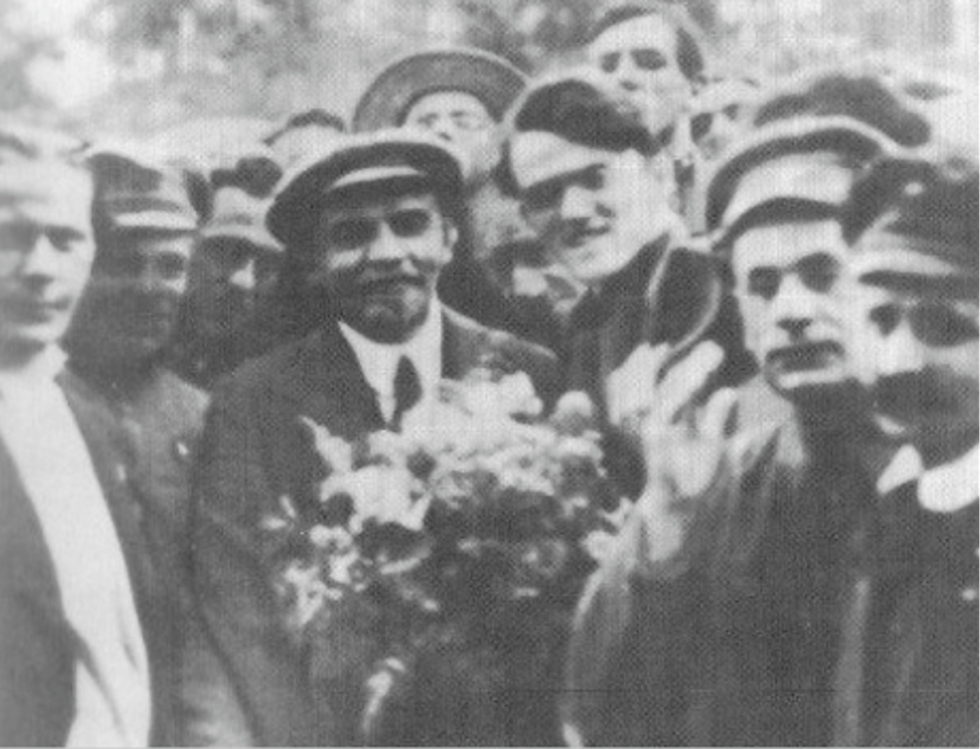
While Roddy Connolly was a firm sympathiser with Soviet Russia by 1920, the logistics of travelling to a state still in the throes of civil war was another matter. Roddy Connolly’s journey to the Second Comintern Congress was a feat of endurance, involving being smuggled from Hull to Norway with the support of two Finnish Comintern agents and then getting on a cargo ship. After being blown off course, Roddy Connolly eventually reached Murmansk and took a long train ride to Petrograd, where he met Lenin (above) and other leading revolutionaries.
In speeches and reports to the Comintern, Connolly emphasised Ireland’s importance in world revolution and in the struggle against British Imperialism. He urged all international representatives to support Communist groups in Ireland. While the Communist movement in Ireland was only at its fledgling stages, he argued that developments in Ireland were of major international importance for two main reasons: the size of the Irish diaspora—particularly in the US—and Ireland’s geographical proximity to Britain, which meant it could both mobilise wider support and strike at the heart of British imperial power.
Responses to Ireland
But how far was Roddy Connolly’s argument taken seriously by Russian revolutionaries? Russian political interest in Ireland was more established and politically diverse than is generally acknowledged. Russian newspapers and journals engaged with Irish politics from at least the late 19th century, reporting keenly on Fenian and Republican opposition to British rule. Irish land questions received detailed attention in Russia, even helping shape the land policy of the liberal Kadets. Irish politics also had resonance beyond Russia in other parts of the Russian empire. For example, Ukrainian Nationalist publications like Nova rada suggested common ground between the Ukrainian and Irish national struggles.
Roddy Connolly was, in some ways, preaching to the converted in terms of the global importance of Irish events. Both Lenin and Trotsky recognised the significance of the Easter Rising in published writings, even if, as Lenin put it, ‘the misfortune of the Irish is that they rose prematurely, when the European revolt of the proletariat had not yet matured.’ Soviet newspapers Izvestiia and Pravda featured detailed reporting on the Irish War of Independence, which they framed as part of a wider challenge to empires.
Roddy Connolly, along with MacAlpine, helped ensure that Ireland was firmly on the agenda at the Second Comintern Congress. In doing so, he tapped into existing interest in Irish politics in revolutionary Russia. He also built on his family ties and spoke to Lenin in detail about James Connolly’s writings and contributions to European Socialism. Roddy Connolly returned to Soviet Russia the following year and continued to raise Irish interests with the Comintern, for instance by seeking financial support for political prisoners and their dependents during the Irish Civil War.
Complications and legacies
While Roddy Connolly was pleased with his reception in Soviet Russia, not everyone was so enamoured with the new Soviet state. Also visiting Soviet Russia in 1920, Irish-American Socialist activist Patrick Quinlan concluded that Lenin ‘knew nothing of Ireland.’ He was also critical of his treatment by other leading Bolsheviks like Karl Radek, who had previously dismissed the Easter Rising as a Nationalist ‘putsch.’ As Irish-Soviet relations expanded in the 1920s and beyond, there continued to be frustrations and misunderstandings alongside successful cooperation. The growth of anti-Communism in Ireland—encouraged partly by the Catholic Church—provided a significant challenge for those seeking closer links between Ireland and Soviet Russia.
Despite these obstacles, Roddy Connolly would be one of many other Irishmen and women to make the trip to Soviet Russia in the hope of revolutionary inspiration and solidarity. For example, Irish feminist and Nationalist activist Hanna Sheehy Skeffington travelled to Soviet Russia in 1930. She was particularly excited by the increased employment opportunities for women. However, when fellow activist, Rosamond Jacob, visited Soviet Russia the following year, she concluded that the men remained in charge, just like ‘at home.’ Even among sympathisers, conclusions could be mixed.
For Roddy Connolly, the 1920 visit to Soviet Russia was an important moment in a long political career, which took him from playing a leading role in the first short-lived Communist Party of Ireland to being a Labour TD. From the Soviet perspective, his voice helped consolidate interest in Ireland’s potential role in international revolution. Yet it was his father who continued to loom largest in Soviet mythologies of Ireland, including through Soviet political studies of James Connolly and Russian translations of his works.
Roddy Connolly’s participation in the Second Comintern Congress was shaped simultaneously by his experiences in Glasgow, by the example of his father, by his experience in the Easter Rising and by wider international changes. His story serves as a reminder of how the reverberations of the Irish Revolution spread far beyond Ireland itself.
Dr Anna Lively is a Leverhulme Early Career Fellow in History at the University of Strathclyde. Her first book, Revolutionary Connections: Russia and Ireland, 1905-1923, will be published open access by Oxford University Press in the summer of 2026


Comments