


Writer, war hero and proud son of Erin

"IF MORE politicians knew poetry, and more poets knew politics… the world would be a little better place in which to live.” These are the words spoken by John Fitzgerald Kennedy, the first Irish Catholic President of the United States, a man most Irish admire and feel we know. However, what is less known about JFK is he started his professional life as a writer who won the Pulitzer Prize and wrote extensively on political issues including Irish unification. Moreover, it was his experiences of helping survivors of a German U-Boat attack when he was in Glasgow, which influenced his presidential policy of avoiding war at all costs.
What is also extraordinary is that in 1963, when he was not addressing the Cold War abroad and the civil rights movement at home, he was writing a book about improving children’s health. Jack Kennedy, viewed as being the most glamourous of presidents was a bookish man. However, he was also leader of men. In 1962, during the Cuban Missile Crisis, he used his historical knowledge of the military errors that led to outbreak of the Great War, to overrule his own generals’ outdated thinking and thereby avert nuclear disaster. It was this most literary of presidents, who employed his wide-ranging knowledge to shape matters of war and peace during the 1960s. Yet his ascent to greatness was a journey of unexpected twists and turns of fate and history.
Early days
Six weeks after America entered the Great War, John Fitzgerald Kennedy (JFK) was born on May 29, 1917, in Brookline Massachusetts, to Joseph Patrick, Sr and Rose Kennedy. It seemed fitting that second son of the powerful Irish Bostonian dynasty would be born in such an eventful year as his public life would be defined by matters of war and peace. Young Jack’s childhood was one of sheltered Bostonian privilege with summers spent at the Gatsbyesque family home at Cape Cod during the Roaring 1920s.
Local people called the Kennedy estate ‘The Irish House.’ This was because the rich Catholic Kennedy family had the audacity to buy a home in the super wealthy Hyannis area where America’s old WASP families lived. When not sailing and playing touch football, the young Kennedy was having dinner with film stars such as Gloria Swanson. This was a far cry from the famine boat his Wexford great grandfather boarded for the New World in 1848. However, global events were to steer the Kennedy clan back to the old world, when in 1938, President Roosevelt appointed Joseph Kennedy as US Ambassador to Great Britain.
JFK in London
In 1938, on the eve of the Second World War, the family moved to London with their father Joe. The handsome Kennedys became the toast of high society with JFK’s sister Kathleen (Kick) being dubbed the most exciting debutante of 1938 season. The children moved in the same social circles as the future Queen Elizabeth II. However, the years between 1938-40, when Joe Sr served as US ambassador, which Jack referred to as being the ‘innocent season,’ was also marked by a dark side. Jack, a keen student of history, observed intently his father’s involvement in high diplomacy. During this time, he regularly attended the House of Commons visitors’ gallery to listen to Winston Churchill make speeches warning the chamber of the rise of the Nazis. During 1939, JFK travelled across Europe visiting the Balkans and the Soviet Union to learn about the growing threat of war.
Glasgow visit
On September 3, 1939, Great Britain declared war on Germany. Six hours later a German U-boat sank the passenger ship The SS Anthena off the coast of Ireland, it was the first ship attack of the war. Fortunately, more than a thousand passengers survived and were brought back to the ship’s departure port of Glasgow. With his father, JFK made his way to Glasgow to help to give comfort to the American survivors of their Atlantic ordeal. Kennedy stayed at Glasgow Central Hotel and visited the shipwreck survivors, who were given shelter in the Beresford Hotel, the Art Deco building across from the Variety Bar in Sauchiehall Street.
Remarkably, it was in Glasgow that Kennedy gave his first public address, when, he gave a speech to the assembled survivors offering them consolation and reassurance. He made the address in the presence of this fellow Irish émigré, Lord Provost, Patrick Joseph Dollan, the first Irish Catholic to become city’s Provost. Such was the warmth between the two Irishmen that when JFK returned to London, he wrote a personal note to Dollan saying: “I want to thank you for the wonderful way you treated me yesterday.” Kennedy’s charm was not just a public persona but went to the very essence of the man. More importantly, his experience of helping the survivors in Glasgow deepened his understanding of the human impact of war. This was to influence his decision-making when he became president.
First book
His experience in Glasgow combined with his what he observed as Britain’s total unpreparedness for the impending war, led to him write his first book, Why England Slept (1940). At the tender age of 23, JFK gave an in-depth critical analysis of British democracy’s lack of preparedness in dealing with the Nazis threat. When the book was released, it sold 80,000 copies, which was exceptionally good sales for a first-time author. The second Kennedy son looked destined to become a successful writer, whilst his elder brother Joe was being mentored by his father for a future presidential bid. However, the Japanese bombing of Pearl Harbor on December 7, 1941, would irrevocably change the destinies of both Kennedy brothers.
War hero
When America entered the war, JFK did not wait for his conscription papers but left Harvard and enlisted in the Navy. In 1943, when a Japanese destroyer sank Lieutenant Kennedy’s patrol torpedo boat, his crew clung to wreckage miles from shore. JFK began to evacuate his injured crew by swimming each of them to shore and returning to rescue others despite he himself having a back wound. For his heroic actions Jack was awarded the Navy and Marine Corps Medal for extreme gallantry and the Purple Heart. JFK is the only president to receive the Purple Heart. But when asked about how he became a war hero he used his trademark self-depreciating humour quipping: “It was involuntary. They sunk my boat.”
However, in August 1944, when his older brother Joe was killed when his bomber exploded on the top-secret Operation Aphrodite Mission, JFK stepped up to the plate. Jack the writer became John the politician as his father began to mentor him for a future presidential bid. Yet he continued to write and was acutely interested in Irish affairs. In the summer of 1945, the demobbed lieutenant headed to Dublin to interview Eamon de Valera on the issue of ending partition. The article published in the New York Journal-American entitled: ‘Eamon de Valera Seeks to Unite All Ireland.’ Early on in his life, Jack intently studied Dev and had a lifelong respect for the Irish President.
Pulitzer Prize
During the 1950s, whilst Kennedy began his political career as a young Senator, he continued to write. In 1957, he won the Pulitzer Prize for his book Profiles in Courage (1956). Written while recovering from back surgery, this book profiled eight US Senators who risked their careers to fight for their personal beliefs. JFK, not yet 40, had established himself as an award-winning writer and respected journalist and was now making his bid for the White House.
White House
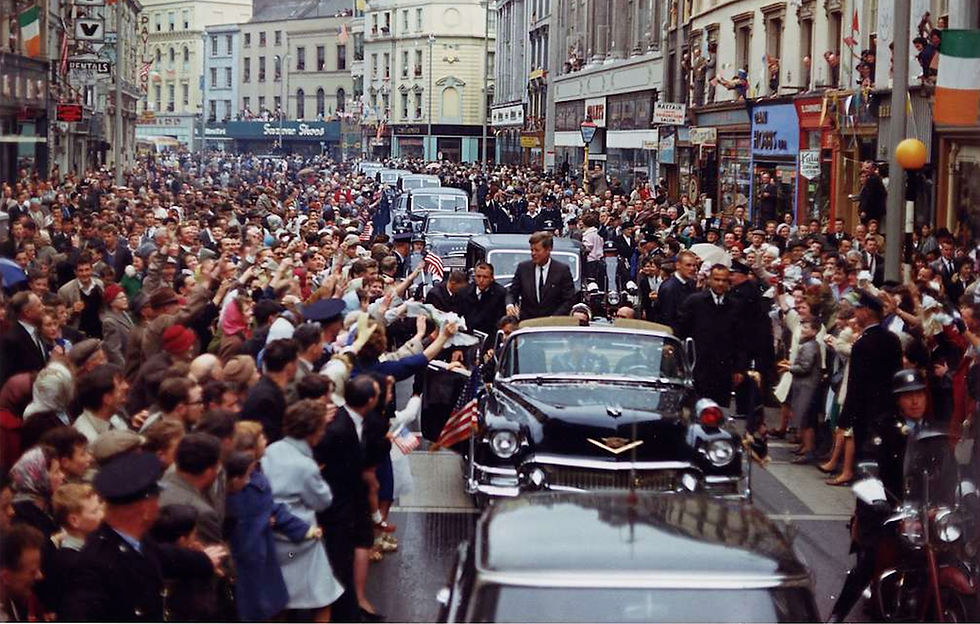
In 1960, John Fitzgerald Kennedy became the youngest elected President and first Catholic to sit in the Oval Office. It was his deep knowledge of literature and history that helped him guide his country peacefully through some of the most turbulent crises of the 20th century. Sandwiched between international Cold War confrontations and giving domestic executive leadership on civil rights, JFK visited Ireland in June 1963.
By the third year of his presidency, the charismatic Kennedy had lived a live that was full, socialising with Sinatra’s Ratpack and had been given the presidential treatment in Paris. Yet he described his visit to Erin as: “The best four days of my life.” When he addressed the Irish people in Dublin he affectionately said: “This is not the land of my birth, but it is the land for which I hold in the greatest affection and I will certainly come back in the springtime,”
Tragically, JFK was assassinated in Dallas on November 22, 1963. On November 25, President Kennedy was given a state funeral in Washington DC in the presence of world’s heads of state. In what was the most iconic and poignant images in American history, a single black riderless horse signifying a fallen leader led the funeral procession. Presidential protocol dictated that America’s elite Infantry regiment—The Old Guard—perform the graveside rifle salute. This honour the regiment jealously protected, especially as JFK was a war hero and recipient of the Purple Heart. Yet at the request of his widow, the Old Guard stood aside to allow the Irish Army Cadets to perform the ‘Queen Anne Drill,’ which Kennedy had witnessed and so admired in Dublin five months previously. This is only time that foreign troops have rendered honours at the funeral of an American President. Standing to attention at Arlington National Cemetery, as the young Irish Cadets performed their drill, was Eamon de Valera, another American-born Irishman, paying his final respects to a fellow president.
Legacy
Jack Kennedy’s aura still fascinates us more than 60 years after his tragic death. There were so many facets to his life, some of which were not noble, including his womanising, which clearly caused immense hurt to his young wife Jackie. Yet like most charismatic men, he was complex. However, when Americans have traditionally chosen their leaders, one essential facet that they look for in a president above all other qualities is character. Jack Kennedy had it in spades. Central to his character was his learned reading which helped him speak so eloquently and enabled him to write many of his own speeches.
His literary background enabled him to communicate directly to a worldwide audience and articulate his ideas with a winning blend of sophistication and clarity. In October 1962, when the world stood on the brink during the Cuban Missile Crisis, he showed presidential resolve by stating: “Our goal is not the victory of might, but the vindication of right.” Yet when the crisis was over, he held out the hand of friendship to the Soviet leadership. On June 10, 1963, the writer-cum-president delivered his ‘Strategy of Peace’ speech stating: “We all inhabit this small planet. We all breathe the same air. We cherish our children’s future. And we are all mortal.” The current president would do well to take note. President John Fitzgerald Kennedy: writer, war hero, and proud son of Erin.
Dr David McKinstry is a teacher and poet whose poems are widely published and broadcast across Ireland and in the UK. If any readers wish to share their literary output with him, they can contact him at: davmick38h@yahoo.co.uk


Comments