


Moya was a magnificent woman

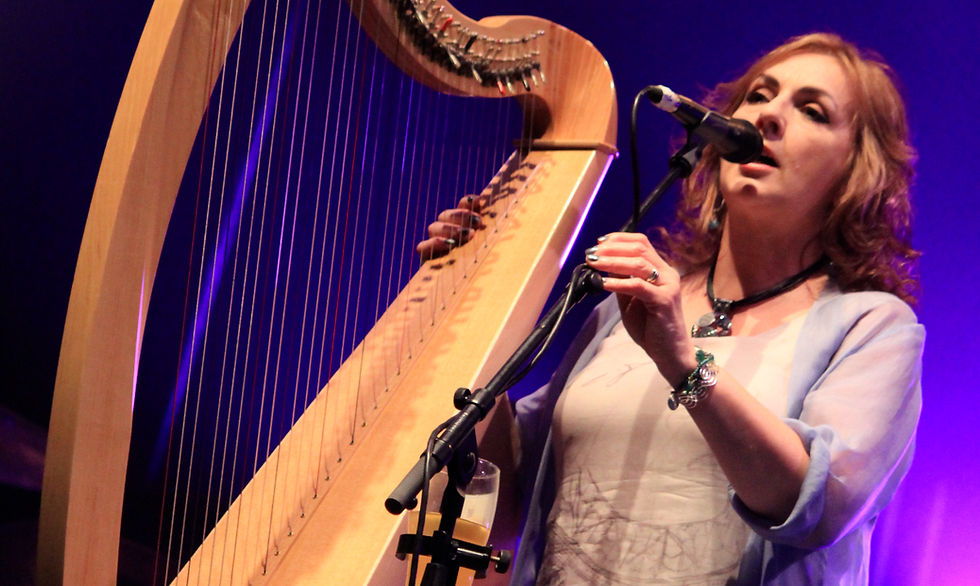
I WAS in Donegal for a long weekend last month. Back to my ‘spiritual home.’ The place I go to decompress and recharge the aul batteries. While I was there, I was reading a lot of John O’Donohue, in particular a piece he wrote about death, and it resonated with me on a deep level because my time there coincided with the funeral of the ‘First Lady of Celtic music,’ Moya Brennan. So, I witnessed first-hand this deep out pouring of love for her. They were talking about her on the radio, the TV, in shops and restaurants, in homes. Donegal was in mourning. I arrived into my Auntie Margaret’s home in Ranafast the day after Moya’s funeral. My cousins, Clann Mhic Ruairí—Tony, Aodh, Dónall, Seán and Megan Rodgers—had sang at the funeral at Moya’s request. Cousin Seán told me he had visited Moya a couple of weeks before she passed and she asked him and his siblings to sing. Naturally they were honoured to do so. It had been an incredibly emotional day, obviously, but Seán reflected on the beauty and simplicity of it too and told me how Moya had every last detail of her own funeral planned with precision long before she passed away on April 13.
Born the eldest child of Leo and Máire (Baba) Brennan, she was the product of the collaboration of two families steeped in the music of Ireland—the Brennans and the Duggans who together formed Grammy and BAFTA winning band, Clannad. She was a singer, songwriter and musician whose international career spanned decades, selling millions of albums worldwide. But for those who knew Moya Brennan, she was simply Moya. Seán told me that Moya (above) never saw herself as anything special and she treated everyone the same way. In his words: You could be Joe Bloggs or Joe Biden, she never made a difference!
She spoke to Seán at length about death; that she was ready to go. “Sure I’ve done it all,” she said. “I’ve married, I’ve raised a family and I’ve travelled all over the world with the band.” She was in complete acceptance of her imminent destiny, just as she was when she was given her diagnoses. It is what it is, she said. We all have to go sometime. You couldn’t help but admire her strength and dignity.
Seán told me that even at her sickest she would come into Leo’s and sing for an audience, as recently as Christmas 2025, then she would have to go and put on her oxygen mask as soon as she came off stage. She never stopped. She told her family that she had already had an experience of ‘passing over’ and so she knew what she was going to. She said there is no night and no day and I’ve seen family there. If you knew what was ahead you wouldn’t be afraid.
A life lived for others
Seán remembers well how they talked about her last world tour with Clannad for their 50th anniversary, which concluded in 2024. He said to her, this must be so exciting for you Moya, going off to travel the world. Her reply was pragmatic. Seán, it’s great, but it’s hard work and there’s nothing glamorous about it. It’s a job. We do a gig, we’re applauded, then the audience leaves and the stage is cleared. We’re left then to pack up, get on a bus and move on to the next gig. This came from the woman who Bono described as having the voice of an angel, but Moya Brennan by all accounts was an ‘angel’ in more ways than we could ever possibly imagine. “She would do anything for you,” Seán said. “Her life was always about everyone else.”
This was evident in her dedication to ‘Clubeo,’ the open mic event she initiated about 13 years ago in Leo’s Tavern, the family’s Chroithlí (Crolly) based bar, restaurant and music venue. It began with local talent coming in once a month to play for an audience, among them many Irish musical celebs known to Moya who she’d invite along to listen and critique, advise and guide. Very soon word spread and Moya had the best of Ireland’s raw talent coming from every county.
She told my cousin, Dónall her ethos: “I want to give back. This is where I started; now I want to help other young singers and musicians.” Among them are now household names like Dermot Kennedy from Dublin and Eve Belle from Ballybofey, Donegal.
Moya was adamant Clubeo must continue on and so she has left it in the very capable hands of my cousin Aodh and his wife Geraldine Rodgers, who I’ve no doubt will take up the mantel and ensure its continuing success. Moya wanted this to be her legacy and I’m told she has every month’s talent list pre-arranged right up until November 2026.
I have a powerful sense of who Moya Brennan was and all that she stood for. Her life was all about other people and not herself. She was as grounded as the bog turf and had a heart the size of Errigal. She was good to the core, open hearted, a kind and generous woman and every person she came into contact with felt that intensely. Even when she sang, she disliked people filming her; often telling her audience to put away their phones and be in the moment. Just listen to the music and enjoy it, she’d say. Her good friend and musical peer, Mairéad Ní Mhaonaigh of Altan describes her so intimately: “With Moya it’s all about the song and her unique sound. She may be gone but the voice will remain.”
A fitting farewell
Her funeral was a true reflection of that. The Mass was in St Patrick’s Meenaweal, Crolly, where her dad, Leo, played the organ in the choir, so she ensured the chapel’s choir would be singing, which they did, along with a recording of Moya’s voice. Daniel O’Donnell and his wife Majella did the psalm. Cormac De Barra—who has an album with Moya and played with her when De Dannan reformed—played the harp. Mairéad Ní Mhaonaigh also sang, and my cousins, Clann Mhic Ruairí, finished off the proceedings with a stunning song called Thos Cois na Trá Domh (Down by the shore I am), which is a traditional Irish lament exploring themes of isolation and nature and describes a solitary figure walking along the shore at night thinking about loved ones who have passed on, which was so fitting for Moya’s final farewell.
I’m going to leave you with this stunning piece written by John O’Donohue called The Invisible Embrace. I feel it will give comfort to Moya’s loved ones and friends and to all of you who have lost someone close.
“The dead are not distant or absent. They are alongside us. When we lose someone to death, we lose their physical image and presence, they slip out of visible form into invisible presence. This alteration of form is the reason we cannot see the dead. But because we cannot see them does not mean that they are not there.
“Transfigured into eternal form, the dead cannot reverse the journey and even for one second re-enter their old form to linger with us a while. Though they cannot reappear, they continue to be near us and part of the healing of grief is the refinement of our hearts whereby we come to sense their loving nearness.
“When we ourselves enter the eternal world and come to see our lives on earth in full view, we may be surprised at the immense assistance and support with which our departed loved ones have accompanied every moment of our lives. In their new, transfigured presence their compassion, understanding and love take on a divine depth, enabling them to become secret angels guiding and sheltering the unfolding of our destiny.”
L J Sexton, mum of four, returned to university to pursue her passion for the written word. She achieved her Honours Degree in English Literature and Creative Writing and hasn't stopped writing since. Lyn is born of Irish parents and lived in Donegal for eight years. She is also the press officer for Irish Minstrels CCÉ music group based in St Roch’s Secondary School


Comments