


Oscar was a man of great importance


WHEN my son, Gabriel Cormac, was accepted to Law at the University of Glasgow, I had never been so proud of him. I paid for his rites of passage sixth year leavers’ party trip to Corfu. But I wanted to give him gifts of value rather than something that had a mere price. So, I decided to give him my two most prized possessions that I have carried with me throughout my adult life. The first was a simple set of wooden Rosary beads that my grandmother had brought with her from Omagh, County Tyrone. This was to remind him of the country we came from and the religion we practice. The other was as equally Irish but from a different side of Erin’s tradition. The precious gift I gave Gabriel was The Complete Works of Oscar Wilde with my personal inscription: “This is the greatest Irish writer that ever lived. You must read him cover to cover.” Such is my admiration of Wilde that my usual detached style of column writing has been temporarily abandoned to pen a personal tribute to Wilde and why I believe he is Ireland’s greatest writer.
Young Oscar
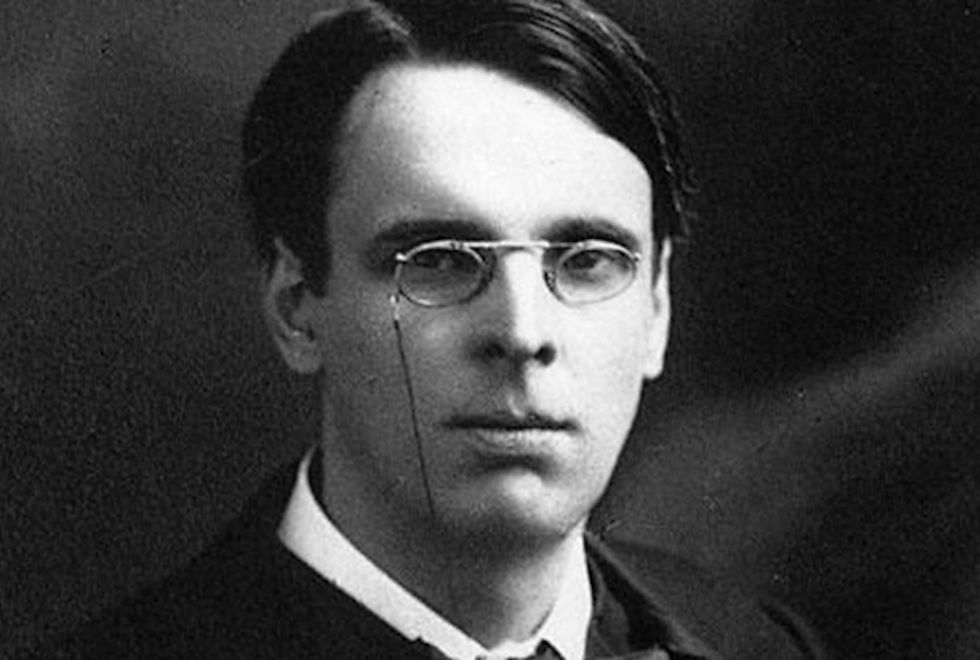
Oscar Fingal O’Flahertie Wills Wilde was born on October 16, 1854 in Dublin. His parents, Sir William Wilde and his author mother Jane Wilde were part of the Anglo-Irish Protestant ruling elite. His father, a doctor, like many of the Anglo-Irish social elite was staunch in his anti-Catholicism. However, Wilde’s father’s anti-Catholicism had a pedigree of its own, his ancestor was a Dutch soldier, Colonel de Wilde, who came to Ireland with William of Orange’s invading army in 1690. Wilde senior’s anti-Catholicism was not only an historic legacy but was fervently held by him. When Oscar considered converting to Rome, his father threatened to cut off his student allowance and disown him.
Yet it was his writer mother that was to have more influence on the young Oscar. Jane Wilde was an author of Irish folktales and a dedicated supporter of Irish Nationalism and independence. Her Nationalism and her reciting of the Young Irelanders’ poetry was to have a profound effect on her son’s identity as an Irishman.
Lord Carson
Young Oscar spent his summer holidays in Wexford with another fellow Anglo-Irish family, the Carsons. Their son Edward would have an extreme impact on Wilde and on the course of Irish history. Oscar’s childhood friend would later lead the prosecution of Wilde in his trial for gross indecency and become Lord Carson the bowler-hatted leader of the Ulster Unionist campaign against Home Rule for Ireland. The young friends Oscar and Edward went to Trinity College Dublin together. When both left for England, they led separate lives until fate led to their paths crossing again, when the Marquess of Queensberry hired Carson to cross examine Wilde in his infamous sodomy libel trial.
Oxford years
In 1874, after achieving a first-class degree in Classics at Trinity, Wilde went to Magdalen College, Oxford. It was during his time there that Wilde the Dandy got into his stride. He began to be associated with the emergent Aesthetic movement, which promoted the idea of arts for art’s sake and art does not have a purpose—it simply needs to be beautiful. Or as Oscar more succinctly put it: “All art is at once surface and symbol.”
Oscar lived up to his surname, the tall Irishman became the most flamboyantly dressed student in Oxford with his long hair and brightly coloured suits and silk scarves. Wilde cut a striking figure among the English elite. However, he was also an Irish outsider and upstart studying at citadel of the English aristocracy. This was evident when Wilde, an exceptional student, was denied membership of the class dominated Oxford Union. The English elite were attempting to put the Irish maverick in his place. This extended to physical attacks, when four students attempted to beat up Wilde, the Trinity champion boxer single handedly beat the four. Wilde was certainly a dandy, but when it came to the art of boxing, he was no shrinking violet. Oscar gained a first-class degree and had the final say on the matter quipping: “The only way to atone for being occasionally over-dressed is by being always absolutely over-educated.”
Wilde, wild west
In 1878, Oscar graduated from Oxford with a Double First, and the bright lights of London soon beckoned him. Always one to make a mark on society, upon arriving in London, Wilde quickly became friends with Lillie Langtry, the most glamourous and famous woman in Britain. The actress was Wilde’s entry into London High Society and the young Irishman never looked back.
What was remarkable about Wilde for the time, is that he became famous before he had written anything of significance. It was his flamboyant personality that attracted people to him before he seriously started writing. He lived by his own maxim that ‘life imitates art’ and constructed a cult of personality that was Oscar Wilde, and which attracted countless famous admirers. No more so was this shown when in 1882, Gilbert and Sullivan’s manager Richard D’Oyly Carte, invited Wilde to a do a lecture tour of the USA to discuss the philosophy of Aestheticism—art for art’s sake. Wilde was due to tour for four months, but such was his popularity he stayed for a year and lectured to packed audiences across the United States.
What was astonishing is that it was not only educated middle classes that turned out to see the Dublin Dandy, but cowboys and gold-miners packed the theatres to listen and laugh at this emerging superstar. Even when he was poking fun at the US’ lack of European Royal pageantry commenting there are ‘only two processions—one was the Fire Brigade preceded by the Police, the other was the Police preceded by the Fire Brigade.’ The Yanks and the Irish-Americans in particular, lapped it up and came back for more of Wilde’s wit.
Defending Parnell
In 1884, Wilde returned to London a rich young man on the back of the success of his American tour. It was during that time he met his wife, the writer Constance Lloyd. He described Constance and their relationship as being ‘quite perfect… We are, of course desperately in love.’ The couple quickly married and set up home in Chelsea. Two sons, Cyril (b.1885) and Vyvyan (b.1886) soon followed.
It during these domestic family years of the late 1880s, the Dubliner established himself as a journalist. Oscar, like his mother, was an Irish Nationalist and when Charles Stewart Parnell was falsely accused of inciting murder, Wilde wrote a series of articles in the Daily Chronicle defending his fellow Irishman. Wilde the journalist was outspoken in his politics and condemned Victorian hypocrisy regarding society’s treatment of the poor. In his essay: The Soul of Man Under Socialism (1891), he commented: “Sometimes the poor are praised for being thrifty. But to recommend thrift to the poor is both grotesque and insulting. It is like advising a man who is starving to eat less.” The essay was so influential that it inspired revolutionaries in Tsarist Russia and across the European continent.
Dorian Gray
By 1890, although a well-paid journalist, the newspaper trade did not suit the temperament of the Dublin maverick, and it was to writing that he would return. In 1890, the novel The Picture of Dorian Gray was published. The novel is about a young socialite who has a portrait painted of him when he is the full bloom of youth. When looking at the painting it dawns on Gray that he will never be as young again. In his melancholic state he inadvertently makes a Faustian bargain with supernatural forces in which only the painting will grow old, and he will stay young and handsome forever. Gray begins a Lord Alfred Douglas life of excess and sin and remains supernaturally young whilst the portrait becomes old and disfigured reflecting his life of sin. Dorian comments on his split personality observing that: “Each of us has heaven and hell in him.” The idea for the book was discussed during a dinner with Arthur Conan Doyle of Sherlock Holmes fame. Remarkably during their meal, Dorian Gray and the Holmes classic The Sign of Four were given their literary conceptions.
Queensberry Rules
It was during the early 1890s and at the height of the commercial successes of his plays Lord Alfred Douglas that Wilde’s lifestyle increasingly moved from flamboyant to dangerous. Oscar increasing courted the company of young men in London’s illegal gay scene. Wilde’s fall from grace would be spectacular when he began a very public relationship with the young Lord Alfred Douglas known to his family as Bosie. At a time when gay men had to be discreet for fear of imprisonment, Bosie lived with open abandonment and introduced Wilde to the Victorian underground of male prostitution. Wilde was in his most hedonistic period, and this was reflected in one of his most famous quotes saying that he could ‘resist everything except temptation.’
Douglas’s father was the Marquess of Queensberry—the creator of modern boxing rules—and openly accused Wilde of sodomy. By then, in 1895, Wilde was the most famous man in London and was living on the commercial successes of his plays, the latest of which was The Importance of Being Ernest. Filled with hubris, and against the advice of his friends, Wilde sued Queensberry for libel.
Trial of the century
What followed next was the most famous trial of the 19th century. Queensberry hired Oscar’s old university friend Edward Carson QC to represent him. The fellow Dubliner amassed an array of evidence against his old friend and questioned Wilde with forensic detail. Such was the ferocity of the cross examination that Wilde said with uncharacteristic meekness from the witness box: “You sting me and insult me and try to unnerve me.” Carson did not relent and produced numerous pieces of evidence from witness statements of male prostitutes and letters sent to them by Wilde. The case collapsed against Queensberry. The irony of the trial was that it publicly displayed insurmountable evidence of Wilde’s homosexuality. The result of the case was that Wilde was charged with Gross Indecency, which carried with it a compulsory prison sentence.
Before the warrant for his arrest was issued the Liberal Government deliberately gave a brief window of opportunity for Wilde to escape on the evening train bound for Dover. Wilde, the most famous man in Britain, had become its most infamous. He had brought shame on his family, causing his wife unimaginable hurt and financial ruin. Yet, he was being accused of sexual practices that many of the English Establishment participated in, but with more discretion.
Several of his friends had already left for Paris to avoid prosecution and those who remained urged him to board the Dover bound train. Wilde sought the counsel of his mother who advised him to stand his ground and fight the English hypocrites as an Irishman, and if he did, she would stand by him regardless of the consequences. Wilde did not flee to France; he stood and fought them as an Irishman.
Reading Gaol
The Dubliner was duly found guilty of Gross Indecency and sentenced to two-years hard labour. Wilde, the most famous man in the Britain at the beginning of 1895, was, by the summer, bankrupt and an infamous convict. Yet from his prison cell Oscar wrote two masterpieces. The first was the poem The Ballad of Reading Gaol, which is the most eloquent condemnation of capital punishment ever committed to paper. The verses sound like a Gregorian chant which hypnotises the listener with its rhythmic entrancing sorrow that haunts the conscience. The following lines recounts Wilde’s realisation that the man was condemned to hang: “And wondering if the man had done, a great or little thing, when a voice behind me whispered low, that fellow’s got to swing.”
Although his health was failing due to hard labour, Wilde never lost his artistic brilliance. He wrote a letter to his former lover Bosie who had fled to France to avoid the threat of prosecution. The letter De Profundis (From My Depths) is regarded by many writers as the sincerest expression of doomed loved ever penned. Wilde observed that: “For a sentimentalist is simply one who desires to have the luxury of an emotion without paying for it.” The ruined Wilde paid for it with his life.
Last act: Catholicism
In May 1897, Wilde was released from prison. The penniless Oscar left Britain a broken and shamed man to live out his final days in Paris financially supported by his close friends. He intermittently saw Bosie who flitted in and out of his life like an ill wind. Wilde, who was dying of meningitis that he contracted in prison, was Baptised as a Catholic. He felt that the Church accepted both sinners and saints and believed that: “Catholicism was the only religion to die in.”
Oscar Wilde died in Paris on November 30, 1900, aged only 46. There are many things written about Wilde, but the Irish maverick knew himself and had the courage to be himself. This was reflected in the life he led, which had many faults, but was truly a work of art. In 1882, when he was about to enter the US and asked at the Customs House if he had anything to declare? He replied: “I have nothing to declare except my genius.”
Dr David McKinstry is a teacher and poet whose poems are widely published and broadcast across Ireland and in the UK. If any readers wish to share their literary output with him, they can contact him at: davmick38h@yahoo.co.uk


Comments