


Darren and Shane know their Blues
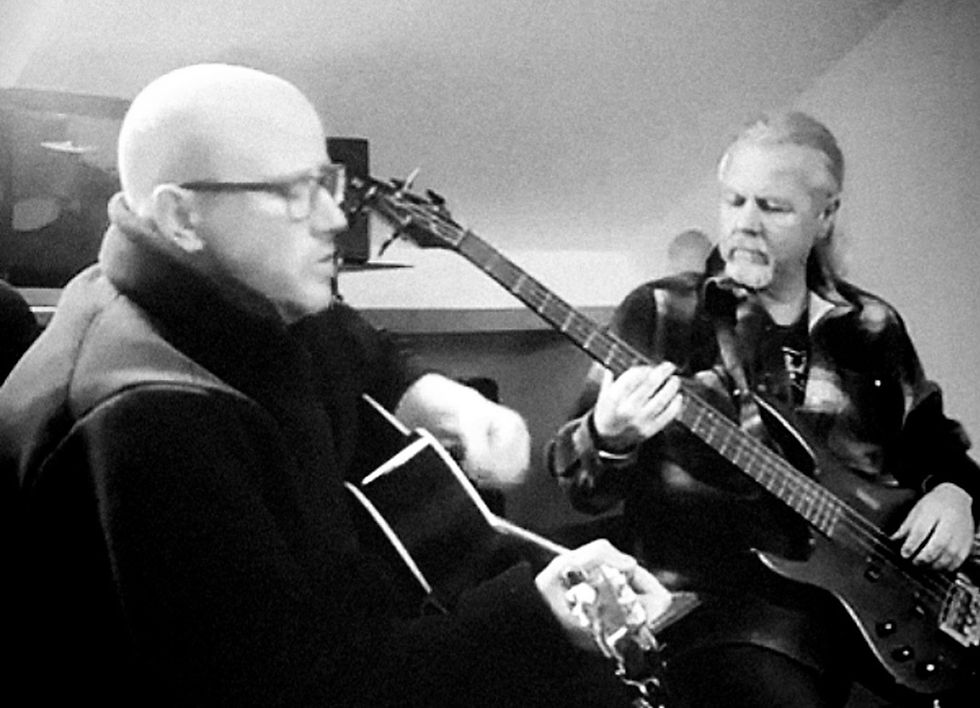
GLASGOW Irish Bands and Gigs makes its return to the pages of The Irish Voice, bringing us an interview with Darren Devereux, who along with Shane Quinn make up the band Sciante Blues.
How did you and Shane meet?
Shane and I have known each other for more than 35 years. Shane lived five doors from where I grew-up. Our families were close. For example, his sister Fiona was our babysitter and his father Frank would drive our family to County Wexford for holidays during the times we didn’t have a car. In short, we have been neighbours for years.
At what stage did you both get into music?
I started to play music on the piano and keyboard from about 10 years of age by taking lessons in school, but it wasn’t until I was about 18 that I picked up the guitar—and haven’t put it down since.
Shane would have started to play music around 16 years of age. While he initially considered playing the drums, he settled on the bass guitar.
Who were your main musical influences growing up?
My biggest influence growing-up would have been Christy Moore. I have listened to him since I was 13. I’ve seen him perform live many times and even managed to get him to sign one of my guitars. His music became the gateway into other Irish folk musicians such as Liam Clancy, Finbarr Furey and Declan Sinnott. In fact, it was Dec who got me to pick-up the electric guitar. Hearing what he could do with the Irish ballads blew my mind.
I’d also have to give a nod to my late uncle Michael Lindsay. He was a fabulous ballad singer and introduced me to Planxty and Moving Hearts.
Shane’s main influence for playing the bass guitar is the late Cliff Burton of Metallica, and Steve Harris of Iron Maiden.
Were your family musical or are you the first to take the decision to become a musician?
In addition to my uncle Michael, my late mother loved to sing and she helped me get into the Irish ballads for sure, but they didn’t play an instrument. The only person in my family who I’m aware of who played an instrument was my late Great-Uncle Paddy McDonald. He was a professional musician who played and taught the flute and piccolo.
Shane’s Grandmother was an accomplished pianist, so there is definitely the musical gene in the Quinn family DNA too.
How did someone with a rock background team up with an Irish folk singer?
Great question! On the back of the odd sing-song in my mother’s house over the years we would’ve been asked to play at more formal family events such as a family Christening or Communion. We’d play mostly folk and rock songs. While Shane predominantly comes from a rock background, he’s also a fan of Irish music, so much so that he can play the Irish whistle and the bodhrán. So it’s a match made in heaven as they say.
Where did you get the band name from? Do the rock and folk influences ever come into your music and how do you complement one another’s styles?
Not only does the name Sciante Blues’ encompass some of our influences—John Frusciante—but the word ‘sciante’ means ‘to know’ in the universal language of Esperanto. In other words, the band name means ‘to know blues,’ not in the 12-bar meaning of the word, but more in the general sense as in sadness. I have always been drawn to the more sombre and darker ballads. Songs such as Boolavogue, The Town I Loved So Well and The Ballad of Little Musgrave, I feel resonate at a much deeper level with me. One other little thing about the name that not many people know: ‘Sí an Tae’ translates from Irish to English to ‘Her tea.’ I believe my mother would have really liked our music—you could even say it would have been ‘her cup of tea’—so the name is also way to acknowledge my mother’s influence.
When we compose music, our folk and rock influences are always there. This is most notable when I hand Shane a demo of a new song I’m working on. I love handing it over to him as he has brilliant ear for where the song needs to go next. Whether that is a subtle bass line, or more energetic tempo he always elevates the song and story I’m trying to tell.
You started writing your own songs in 2023. Why did you choose to do that then?
Following Lockdown, Shane and I started to play together more frequently. We’d play covers, and would jam a lot. Sometimes a riff or chord progression would catch our attention and we’d see if something would come from it. That was the start of us creating our own music.
In addition, we felt we had something to say. Not only had we experienced great changes in our personal lives over the previous few years, but Ireland was experiencing rapid cultural changes. Taken together, we felt ready to tell Irish stories through my music.
You’ve released four singles such as Fallen Angel and also The Ballad of Pádraig Pearse. What was the inspiration for those songs?
Fallen Angel is a deeply personal song about my experience of living with someone who used alcohol to ease their pain and suffering. Watching that person lose their sense of self over many years was heart-breaking. However, in the days before passing over to the next world we managed to reconnect in the ways we would have prior to their dependency on alcohol. So, Fallen Angel describes the journey of losing someone, but finding them again under most tragic circumstances.
In terms of The Ballad of Pádraig Pearse, that was one of those songs that was put together in less than 24 hours. Living beside St Enda’s Park—the place where Padraig Pearse had his School—all my life, I have visited the museum countless times, but one morning last year I had a spare hour and decided to go through the museum in detail. The curators there have done a super job with the exhibition. As I walked along the tree-lined avenue in front of the museum I felt compelled to try and tell the story of the sacrifice that underpins Padraig’s struggle for a more just and equal Ireland.
What kind of venues do you currently play?
We have only started to play our music live, so we’ve played only two venues. One was live on radio and the other one was a singer-songwriter’s night in Brady’s Pub Terenure, Dublin. We are planning to share our rebel songs in venues associated with the places that feature in our songs though, such as Wicklow and Wexford.
You are very active on the social media platform Tik Tok, which is where we found you. Have you thought about using other platforms to showcase your music?
While we are on Instagram and have a small but loyal group of followers there, TikTok has been amazing for helping us to connect with like-minded individuals on a much bigger scale. We’ve been delighted with the support we have received on TikTok.
Now that we have those two platforms up and running, we will focus on Facebook and YouTube. In fact, we published a series of videos and released them on our YouTube channel recently. Those videos were created to help viewers to get a better idea of the places and locations that shaped our song about the 1798 Rebellion. For example, one of the videos was shot on top of Vinegar Hill, while another one was filmed at the cottage where Sam McAllister gave up his life for his friend and rebel leader Michael Dwyer.
What route do you see Sciante Blues going down in future?
That’s another very good question. I will continue to write songs about the various movements for Ireland’s independence. We have a rich and deep history with many fascinating stories that are waiting to be told. For example, I’m in the middle of reading the memoirs of Joseph Holt. He played a pivotal role in the 1798 Rebellion, yet there are very few songs about him. For this reason, we are writing a song about his contribution during that Rebellion. In addition to writing about our past, we believe it is equally important to write about some of the current struggles facing Irish people.
How do you find the current music scene in Ireland? Do you think enough is being done to keep the old songs alive?
With the proliferation of technology, access to music has never been easier. Whether you are a consumer, or producer of music it is a wonderful time to be involved in the industry.
As an Irish folk artist there are many brilliant resources available for free. For instance, Duchas.ie is a project that aims to digitise the Irish National Folklore Collection. As one of the largest folklore collections in the world it is a real treasure trove for people like me. Likewise, The Irish Traditional Music Archive is home to the largest, most comprehensive music, song, and dance in the world. And this year Christy Moore donated his personal archive to the organisations—everything from handwritten songbooks to non-commercial recordings are there to inspire the next generation Irish folk artists.
On a more local level, people such as Keith McLoughlin do stellar work promoting independent Irish artists. He hosts a radio show each Sunday where he invites up-and coming Irish artists to play their songs and take part in an interview. In addition, Keith organises a singer-songwriter’s night in Dublin each month. So, there are plenty of opportunities to play.
And going back to social media and TikTok again, it is heart-warming to see so many talented Irish folk singers upload covers or share their original Irish folk songs on that platform. Not only does it help discover new Irish folk singers, but it is an easy way to bring the old song to a younger demographic.
Safe to say, the Irish folk scene is experiencing somewhat of a revival in recent years.
Do you think the Irish music industry is getting enough support these days in terms of promotion?
While human nature will always want more, I think there is enough support for Irish music. People like yourselves have been so supportive of Irish musicians and have helped Irish artists reach a wider audience. Furthermore, recently the Irish Government extended the ‘Basic Income for the Arts’ pilot scheme. This scheme aims to support creative arts workers by addressing the financial instability faced by many working in the arts.
Finally, do you have any plans to play in Scotland and if so, what would be your ideal venue?
We’d love to play in Scotland as the Scots love the Irish ballads. Even Christy Moore has said that his favourite venue to play is the Barrowlands because of the reception he receives when he performs there. So 100 per cent, Scotland would be superb. In terms of a venue, we’d be equally happy to play in someone’s front-room as we would be in Barrowlands, as long as people enjoy a good ‘sing-song,’ we’re there!
Check in with Glasgow Irish Bands and Gigs Facebook page—www.facebook.com/GlasgowIrishBandsAndGigs—regularly for gig listings, guides, features, exclusive streams, playlists, news and more


Comments